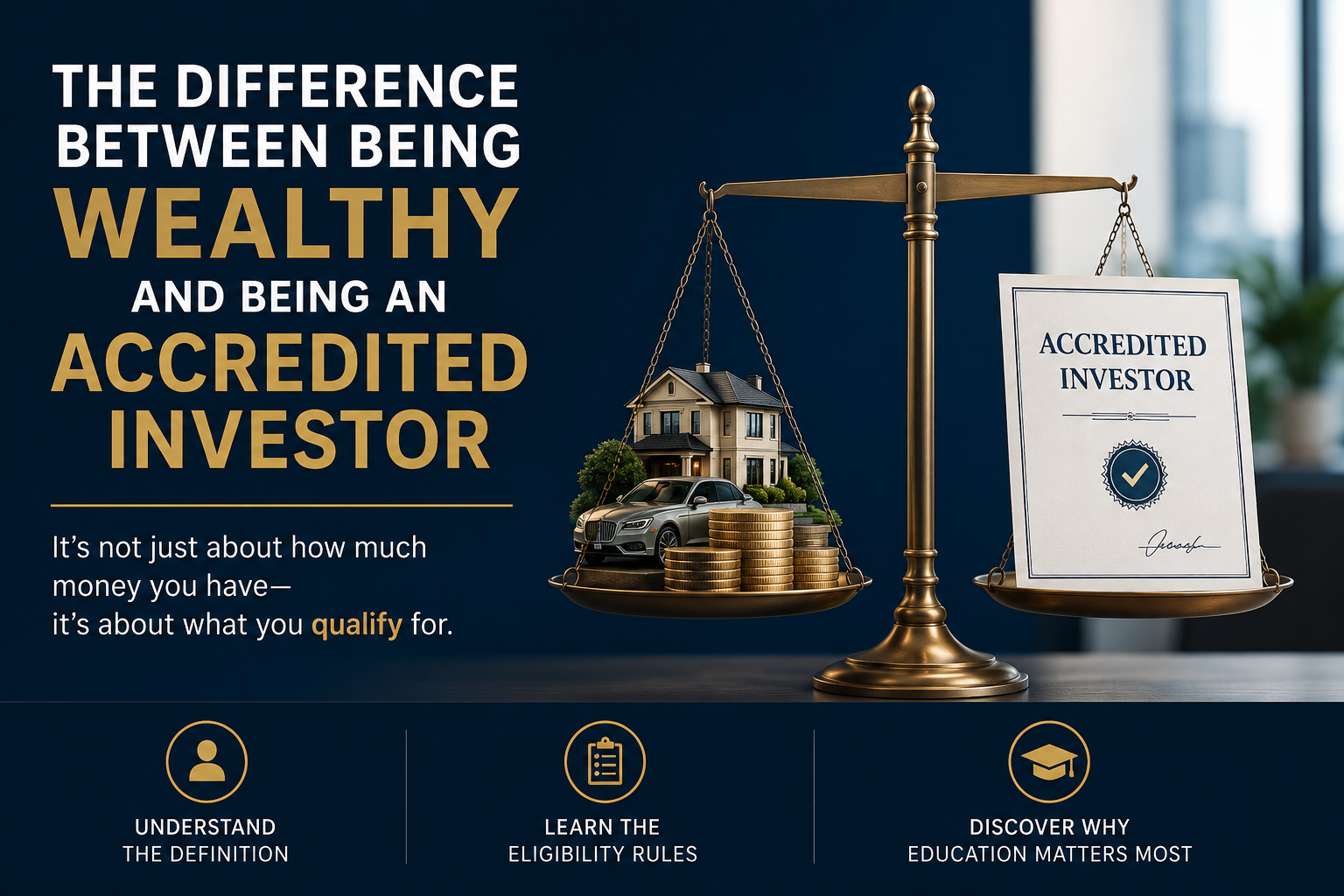
Many people assume that being wealthy automatically makes them an accredited investor. The reality is more nuanced. Understanding the accredited investor definition is important because it determines access to certain private investment opportunities that are not available to the general public.
What Is an Accredited Investor?
An accredited investor is a person or entity that meets certain financial or professional criteria established by regulators. This classification allows investors to participate in certain private investment opportunities that are not registered for public sale.
These may include:
- Private credit funds
- Private equity investments
- Venture capital funds
- Certain hedge funds
- Private real estate offerings
- Alternative investment strategies
These opportunities can provide diversification and return potential, but they may also involve higher risk, reduced liquidity, and less transparency than traditional publicly traded investments.
Accredited Investor Definition: Do You Qualify?
For individuals, qualification is generally based on income, net worth, or certain professional credentials. Our full guide to what an accredited investor is walks through each test in detail.
Income Test
You may qualify if you have earned:
- More than $200,000 annually as an individual during each of the last two years, with a reasonable expectation of maintaining that income level; or
- More than $300,000 annually jointly with a spouse or spousal equivalent.
Net Worth Test
You may also qualify if your net worth exceeds $1 million, either individually or jointly with a spouse or spousal equivalent, excluding the value of your primary residence.
Professional Qualifications
Certain financial professionals may qualify based on specific licenses, credentials, or knowledge-based criteria recognized by regulators.
Sources for the qualification tests above: U.S. Securities and Exchange Commission, Accredited Investors — Updated Investor Bulletin, and Rule 501(a) of Regulation D, 17 CFR § 230.501. Thresholds current as of August 2026.
Wealthy Does Not Always Mean Accredited
Many people who appear financially successful may not technically meet the accredited investor standards.
For example, someone may own a valuable home, have a strong lifestyle, or operate a successful business, yet still fall outside the formal accredited investor definition. On the other hand, a high-income professional may qualify even if they do not yet consider themselves wealthy.
The key point is this: accreditation is a regulatory qualification. It is not a complete measure of financial sophistication, investment knowledge, or overall financial strength.
Why Education Matters More Than Qualification
Perhaps the biggest misconception is that qualifying as an accredited investor automatically means someone is prepared to evaluate private investment opportunities.
It does not.
Accreditation may open the door to more investment choices, but it does not guarantee that those choices are appropriate. Private investments can be complex and may involve:
- Limited liquidity
- Longer holding periods
- Valuation uncertainty
- Manager risk
- Reduced transparency
- Unique tax considerations
This is why education matters more than qualification. A thoughtful investor should understand what they own, why they own it, how it fits into their broader financial plan, and what risks are involved.
Where Alternative Investments May Fit
For some accredited investors, alternatives such as private credit, private real estate, or private equity can serve a useful role within a diversified portfolio.
However, these investments should not be pursued simply because they are exclusive or unavailable to the general public. The better question is whether the investment aligns with your goals, income needs, risk tolerance, liquidity needs, tax situation, and long-term planning strategy.
Final Thoughts
The accredited investor definition is often misunderstood. While many accredited investors are wealthy, wealth alone does not determine accreditation. Likewise, accreditation alone does not guarantee good investment decisions.
The most important question is not simply whether you qualify for an investment opportunity. It is whether you understand it.
Before pursuing private investment strategies, take time to evaluate how they fit into your overall financial plan. Access can open doors, but education helps determine which doors are worth walking through.
Pathworks Financial helps clients evaluate investment opportunities in the context of their broader financial lives, including retirement planning, tax strategy, income needs, and long-term portfolio design.