Alternative investments have moved steadily into the mainstream conversation among affluent and accredited investors. Private credit, private equity, real estate, infrastructure, and other nontraditional strategies are increasingly being considered alongside stocks and bonds when building diversified portfolios.
Yet alternatives remain widely misunderstood.
Some investors assume they are only available to billionaires. Others believe alternatives are automatically more dangerous than public markets—or that investing in them means locking money away indefinitely.
The reality is more nuanced.
Understanding what alternative investments are—and what they are not can help investors make better decisions about whether they deserve a place in a long-term portfolio.
Myth #1: Alternative Investments Are Only for Billionaires
There was a time when many private-market investments were primarily accessible to institutions, family offices, and extremely wealthy individuals.
That landscape has changed considerably.
Today, a broader range of alternative investment strategies may be available to accredited investors who meet applicable SEC income or net-worth requirements. Depending on the investment, minimums can also be substantially lower than the multimillion-dollar commitments historically associated with private markets. Being wealthy and being accredited are not the same thing.
Being eligible, however, doesn't automatically make an investment appropriate.
Accredited investor status is primarily an eligibility standard. The more important questions involve your financial circumstances, liquidity needs, investment objectives, time horizon, risk tolerance, and understanding of the opportunity.
Access is only the beginning. Due diligence still matters.
Myth #2: Alternatives Are Always Riskier
Alternative investments involve real risks. Depending on the strategy, those can include illiquidity, leverage, credit risk, valuation uncertainty, manager risk, limited transparency, and the potential loss of principal.
But saying alternatives are always riskier than traditional investments oversimplifies the issue.
Risk comes in many forms.
A concentrated stock portfolio has risk. Long-duration bonds have interest-rate risk. Holding excessive cash creates purchasing-power risk. A portfolio consisting almost entirely of publicly traded securities can also become highly exposed to the same economic and market forces.
Certain alternative strategies may introduce different sources of return and different types of risk from those found in traditional markets.
That doesn't necessarily make the portfolio safer. But used thoughtfully, alternatives can potentially broaden diversification and reduce dependence on a single market environment.
The objective isn't to eliminate risk. It's to understand which risks you are taking and why.
Myth #3: Everything Is Private Equity
When many investors hear "alternative investments," they immediately think of private equity.
Private equity is only one part of a much larger universe.
Alternative investments can include:
- Private credit — lending capital to companies outside traditional public bond markets.
- Private equity — investing in privately held businesses or taking public companies private.
- Private real estate — investing in properties or real estate strategies outside publicly traded REITs.
- Infrastructure — investments involving areas such as transportation, utilities, communications, and energy infrastructure.
- Venture capital — investing in emerging and early-stage businesses.
- Specialized strategies — including certain hedge fund, secondary-market, structured, and opportunistic investment approaches.
Each category has its own potential benefits, risks, liquidity characteristics, fees, and role within a portfolio.
Grouping them all together as "alternatives" can obscure some very important differences.
Myth #4: You Lose Access to Your Money Forever
Liquidity is one of the biggest considerations when evaluating alternative investments—and appropriately so.
Many alternatives cannot be bought and sold daily like a publicly traded stock or ETF. Some private investments may require capital to remain invested for several years.
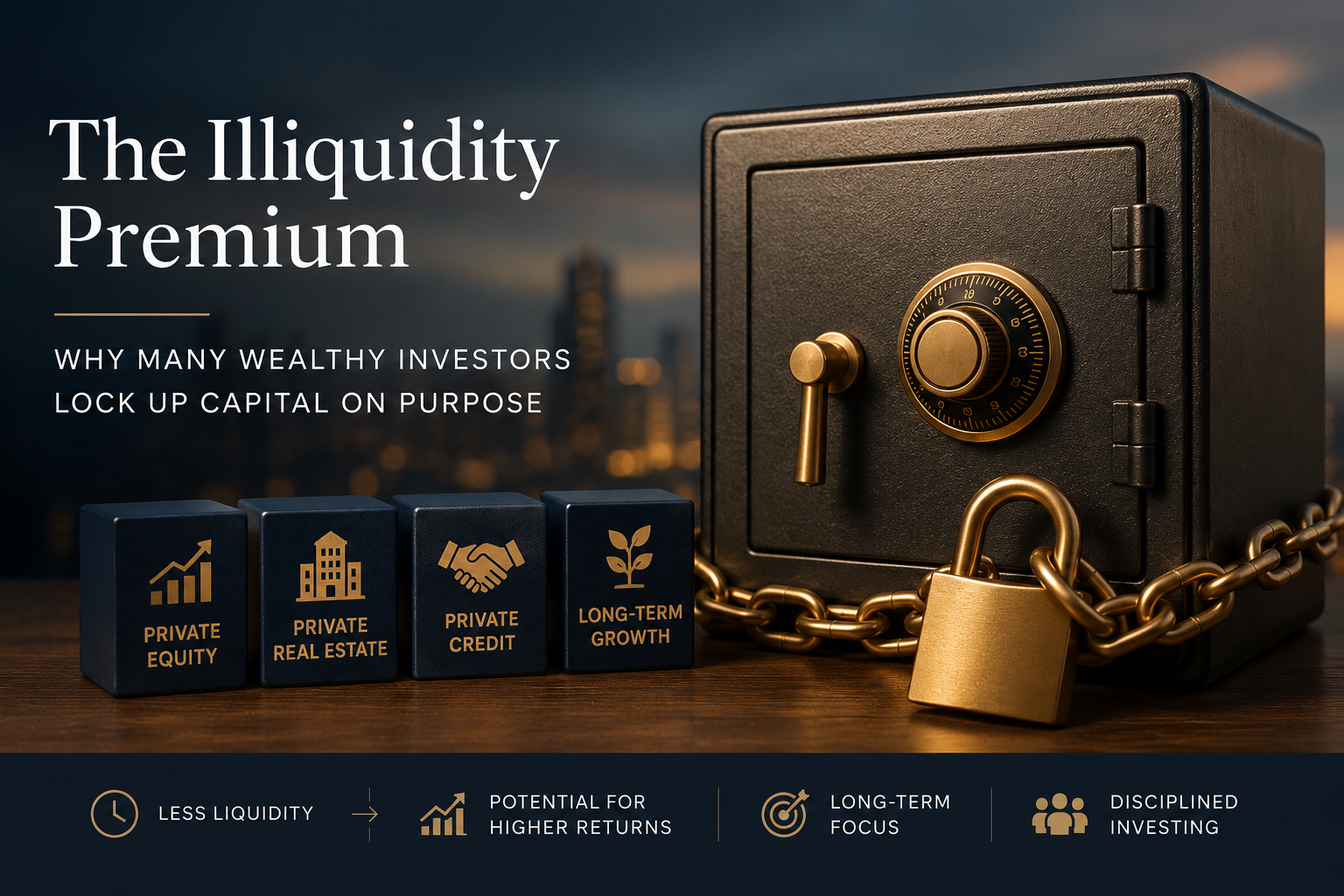
But "illiquid" does not necessarily mean "locked up forever." We cover the tradeoff in depth in the illiquidity premium.
Liquidity varies considerably.
Some strategies offer periodic opportunities for investors to request redemptions. Others have defined investment terms or anticipated exit periods. Traditional private equity may require a significantly longer commitment.
There is another important distinction: requested liquidity isn't always guaranteed liquidity. Some investment structures can limit, delay, or suspend redemptions under certain circumstances.
That's why alternative investments should generally be considered within the context of the investor's entire financial picture.
Money needed for living expenses, emergencies, major purchases, taxes, or other near-term obligations typically shouldn't depend upon an illiquid investment becoming available at exactly the right moment.
Myth #5: Alternatives Are Supposed to Replace Stocks and Bonds
Perhaps the biggest misconception is that investors must choose between traditional investments and alternatives.
For most investors, that's the wrong framework.
A diversified portfolio of public stocks, bonds, and cash can remain the foundation of a long-term investment strategy. Alternatives may serve as an additional portfolio building block, rather than a replacement.
Depending on the investor and the strategy, alternatives might be considered for objectives such as:
- Additional income
- Broader diversification
- Exposure to private businesses and assets
- Reduced reliance on public-market returns
- Potential long-term appreciation
- Access to investment opportunities unavailable through traditional markets
The appropriate allocation—if any—depends on the investor.
Someone with substantial liquidity, a long time horizon, and predictable cash flow may have considerably more capacity for alternative investments than someone who expects to draw heavily from their portfolio over the next several years.
Alternatives Require a Different Kind of Due Diligence
Greater access to alternative investments doesn't eliminate the need for careful evaluation. If anything, it makes that evaluation more important.
Before investing, investors should understand the underlying strategy, manager experience, fees and expenses, use of leverage, valuation methodology, liquidity provisions, potential conflicts, tax consequences, and how the investment complements existing portfolio exposures.
One of the most important questions is also one of the simplest:
What specific job is this investment supposed to perform in my portfolio?
If there isn't a clear answer, the investment may not belong there.
Final Thoughts
Alternative investments aren't automatically better than stocks and bonds, and they aren't automatically worse.
They're simply another set of tools.
For accredited investors with sufficient assets, appropriate liquidity, and a long-term perspective, certain alternative strategies may provide access to sources of income, diversification, and growth that aren't readily available through public markets.
But access shouldn't be confused with opportunity, and opportunity shouldn't be confused with suitability.
The goal isn't to own alternatives simply because you qualify to invest in them. The goal is to build a portfolio in which every investment has a purpose—and where traditional and alternative investments work together in support of the investor's broader financial plan.
At The Accredited Investor, we believe understanding an investment should come before allocating capital to it. The more sophisticated the opportunity, the more important it becomes to understand not only its potential return, but its risks, liquidity, structure, and role within the portfolio.
Because successful investing isn't about having access to everything.
It's about knowing what deserves a place in your portfolio.
Alternative investments involve significant risks, including potential loss of principal, limited liquidity, valuation uncertainty, and other risks that may not be present in traditional investments. They may not be suitable for all investors. Investors should carefully review offering materials and consult their financial, tax, and legal professionals before investing.