
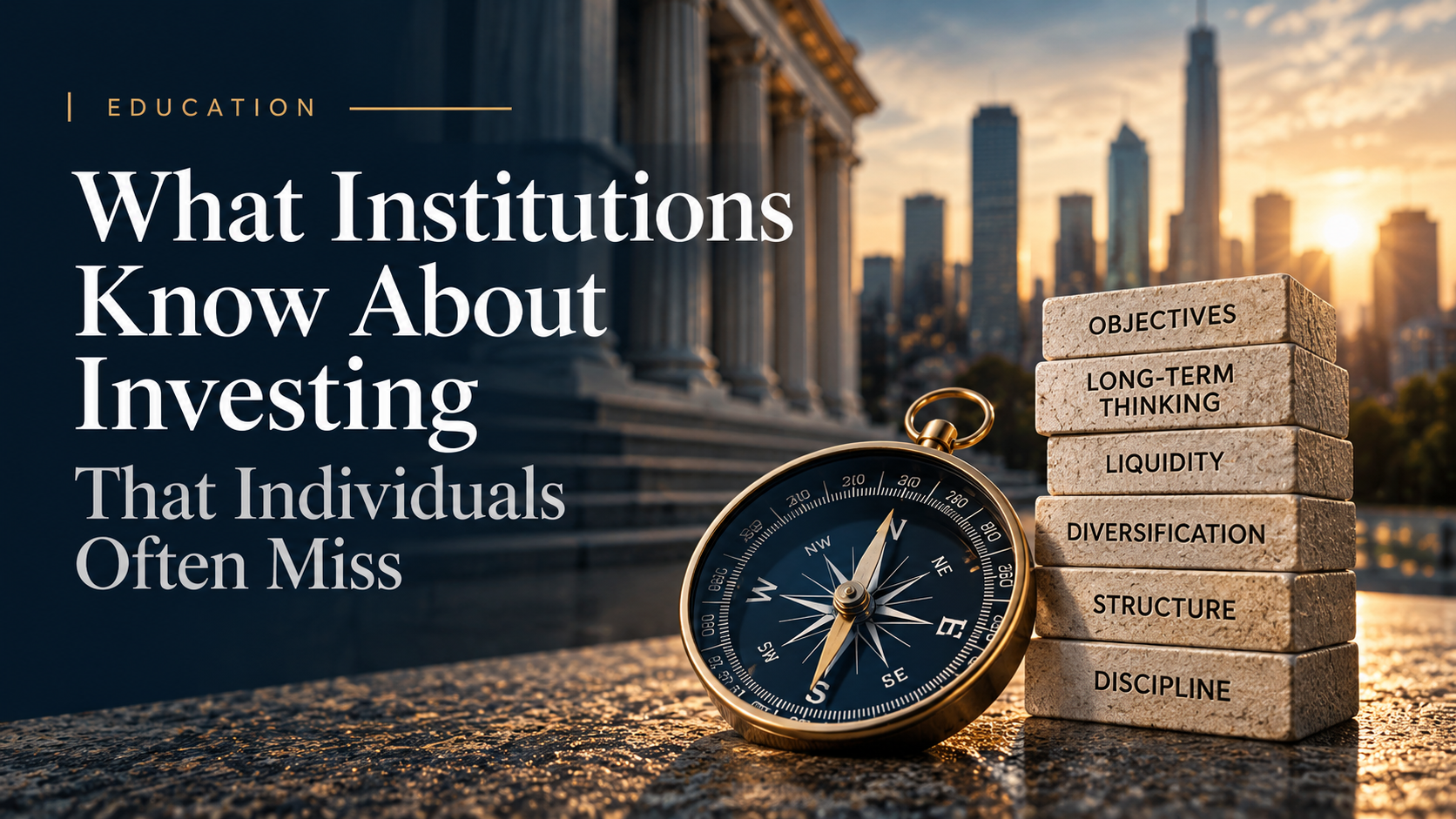
When investors hear about large university endowments, pension funds, foundations, and family offices, it can be tempting to focus on what they invest in.
Private equity.
Private credit.
Real estate.
Infrastructure.
Other alternative investments.
But the more important lesson may not be what institutions own.
It may be how they think.
Institutional investors often operate with longer time horizons, clearly defined objectives, disciplined allocation frameworks, and a willingness to accept that not every investment needs to provide immediate liquidity.
Individual investors may not have the resources of a large pension fund or endowment. But many of the principles institutions use can still help accredited investors think differently about their own portfolios.
1. They Start With the Objective, Not the Investment
Individual investors are constantly presented with investment ideas.
A particular stock looks attractive. A new strategy has performed well. A private investment offers an interesting opportunity. A market theme suddenly becomes popular.
Institutions generally try to approach the process from the opposite direction.
They begin by asking:
What are we trying to accomplish?
Only then do they determine which investments may help accomplish it.
A pension fund, for example, has future obligations it needs to meet. An endowment may be attempting to support an institution today while preserving purchasing power for future generations. A family office may be balancing current lifestyle needs with wealth that could extend across multiple generations.
The investments come later.
For individual investors, this distinction matters.
Instead of beginning with:
"Should I invest in this?"
A better starting point may be:
"What role would this investment play in my overall plan?"
That one change in perspective can lead to a very different investment conversation.
2. They Think in Years and Decades
Institutions frequently have something individual investors struggle to maintain:
A genuinely long time horizon.
Public markets make it incredibly easy to focus on what is happening today.
Markets move constantly. Account values are updated continuously. Financial headlines arrive by the minute.
The result can be an environment in which long-term investors feel pressure to make short-term decisions.
Institutions often have structural advantages that allow them to look beyond that noise.
They may evaluate investments over five, ten, or even twenty years rather than judging success over a few quarters.
That longer horizon also opens the door to investments that do not need to be priced every second of every day.
For accredited investors, the lesson isn't that short-term risks should be ignored.
It's that money with a ten-year purpose shouldn't necessarily be managed as though it has a ten-day time horizon.
3. They Understand That Liquidity Has a Cost
Liquidity is valuable.
Being able to sell an investment quickly provides flexibility, access to capital, and peace of mind.
But institutions also recognize that they may not need every dollar to be immediately available.
That distinction is important.
If an investor has enough liquid capital to meet near-term needs, another portion of the portfolio may potentially be invested for longer periods.
This is one of the concepts behind the illiquidity premium.
Investors who commit capital for longer periods may sometimes receive additional return potential in exchange for giving up immediate access to that money.
That does not mean illiquid investments automatically produce higher returns.
They don't.
And illiquidity introduces meaningful risks of its own.
The institutional lesson is simply that liquidity should be treated as a portfolio resource.
Some capital needs to remain highly liquid.
Other capital may not.
Understanding the difference allows investors to make more intentional decisions.
4. They Diversify Beyond Tickers
When many investors hear the word diversification, they think about owning more securities.
More stocks.
More funds.
More sectors.
Institutions often think more broadly.
They may diversify across different sources of return, different economic environments, different types of assets, and different time horizons.
That may include public equities and bonds, but it can also include areas such as:
- Private credit
- Private equity
- Private real estate
- Infrastructure
- Real assets
- Other specialized strategies
The goal isn't simply to own more things.
It is to understand why each component is in the portfolio and how those components may behave differently under different circumstances.
For accredited investors, that is an important distinction.
A portfolio containing fifteen investments isn't necessarily more diversified than one containing five.
What matters is what risks those investments actually represent.
5. They Focus Heavily on the Structure
Individual investors often spend most of their time evaluating the investment itself.
Institutions frequently spend significant time evaluating the structure surrounding the investment.
They may consider questions such as:
- How long will the capital be committed?
- How will distributions occur?
- What fees are involved?
- Who controls the investment?
- How much leverage is being used?
- How is the investment valued?
- What happens during difficult market environments?
- Who is managing the strategy?
- What incentives does the manager have?
Those questions become particularly important in private markets, where two investments that appear similar on the surface can have very different underlying structures.
For accredited investors exploring alternatives, understanding the structure can be just as important as understanding the underlying asset.
Sometimes more so.
6. They Separate the Portfolio Into Different Jobs
One of the most useful institutional concepts is that every dollar doesn't have to perform the same job.
Some capital may be designed to provide liquidity.
Some may generate income.
Some may provide long-term growth.
Some may attempt to protect purchasing power.
Some may eventually support children, grandchildren, philanthropy, or other legacy goals.
Thinking this way changes the conversation.
Instead of asking:
"What is the best investment?"
The question becomes:
"What is the right tool for this particular job?"
That is a much more useful framework.
There rarely is one investment that provides maximum growth, high income, complete liquidity, low volatility, inflation protection, and capital preservation simultaneously.
Investment decisions involve tradeoffs.
Institutions tend to acknowledge those tradeoffs explicitly.
Individual investors can benefit from doing the same.
The Real Institutional Advantage
The biggest advantage institutional investors possess may not be access to exclusive investments.
It may be discipline.
They establish objectives.
They create an allocation framework.
They define liquidity needs.
They diversify intentionally.
They perform due diligence.
And then they attempt to stay committed to that process through changing markets.
Accredited investors increasingly have access to investment opportunities that once belonged primarily to institutions.
But access is only the beginning.
The more valuable opportunity may be adopting some of the thinking that institutions have used for decades.
At The Accredited Investor, that's the conversation we're interested in having.
Not simply:
What can you invest in?
But:
How should you think about investing once your opportunities become broader?
Because ultimately, a larger investment universe doesn't automatically create a better portfolio.
Better decisions usually begin with a better framework.
Want to keep learning?
Explore more articles and videos at TheAccreditedInvestor.com, where we discuss private markets, alternative investments, family office concepts, and long-term wealth strategy for accredited investors.
This material is for educational and informational purposes only and should not be considered investment advice. Alternative and private investments involve unique risks, including limited liquidity, complexity, and the potential loss of principal. Investors should evaluate any investment in light of their individual objectives, circumstances, and risk tolerance.